




SEO in Content Writing: Powerful Strategies to Boost Rankings
SEO in content writing means creating useful, relevant, and well-structured content that satisfies what people are searching for while making it easier for search engines to understand, crawl, and index the page.
Modern SEO content writing is no longer about repeating a keyword dozens of times. Google increasingly understands topics, context, entities, relationships, and search intent. Its current guidance emphasizes helpful, reliable, people-first content rather than content created primarily to manipulate rankings.
How to Skyrocket Productivity: Powerful Hacks for Students, Professionals & Researchers
For content writers, this means the goal is simple: write for people first, optimize intelligently for search second.

What Is SEO in Content Writing?
SEO in content writing is the process of applying search engine optimization principles while researching, planning, writing, optimizing, and updating content.
An SEO content writer considers:
- What the target audience wants to know
- Which keywords and topics they search for
- What search intent exists behind those queries
- How competitors satisfy that intent
- How the content should be structured
- Which internal and external links add value
- How search engines can understand the page
- How the content can provide direct answers for AI-powered search
Google describes SEO as helping search engines understand content and helping users discover websites through search.
Therefore, SEO content isn’t simply keyword-rich content. It is content that connects a user’s need with a clear, useful, trustworthy answer.
Why SEO Matters in Content Writing
Excellent writing does not automatically guarantee organic visibility.
A well-written article can struggle if:
- Nobody searches for the topic
- The content doesn’t match search intent
- The page has poor structure
- Important information is difficult to find
- Search engines cannot crawl or index the page
- Internal linking is weak
- The article provides little original value
- The content is outdated
- The title doesn’t accurately communicate the page’s purpose
Google’s Search Essentials emphasize technical requirements, spam policies, and key best practices as fundamental considerations for search visibility.
SEO helps bridge the gap between good content and discoverable content.
SEO Content Writing and Search Intent
Search intent is one of the most important elements of modern SEO content writing.
Before writing an article, determine why someone is searching. SEO Content Writing Freelance Made Simple: Everything You Need to Know
The main types include:
1. Informational Intent
The user wants information.
Examples:
- What is SEO?
- How does content writing work?
- What is keyword research?
Create educational, comprehensive content for these searches.
2. Commercial Investigation
The user is comparing solutions before making a decision.
Examples:
- Best SEO content writing tools
- SEO agency vs freelancer
- Best keyword research software
Comparison tables, pros and cons, examples, and evidence can work well here.
3. Transactional Intent
The user is ready to take action.
Examples:
- Hire SEO content writer
- Buy SEO software
- SEO content writing services
These pages should communicate benefits, pricing or relevant commercial information, trust signals, and clear calls to action.
4. Navigational Intent
The user is looking for a specific website, brand, or resource.
Understanding intent prevents writers from producing content that technically targets a keyword but fails to answer the user’s actual need.
Professional seo and content writing services to Grow Your Business Online
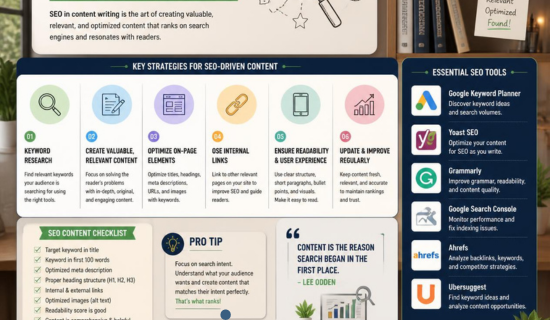
Keyword Research for SEO Content Writing
Keyword research remains an important part of SEO, but modern content shouldn’t be built around exact-match keyword repetition.
Start with a primary keyword, then identify related search terms and subtopics.
For SEO in content writing, supporting keywords might include:
- SEO content writing
- SEO writing
- content writing for SEO
- SEO content writer
- SEO-friendly content
- search engine optimized content
- content optimization
- keyword research
- search intent
- on-page SEO
- semantic SEO
- AEO
- internal linking
- content structure
- E-E-A-T
- organic traffic
- content strategy
Use these terms naturally where they genuinely help explain the subject.
Google’s guidance says its language systems can understand how pages relate to queries without requiring creators to include every exact keyword variation.
The Ultimate Handbook for Choosing the Best Content Writing Services
The objective is topical coverage—not keyword stuffing.
How to Use Keywords Naturally
Place your primary keyword where it makes sense, such as:
- SEO title
- H1
- Introduction
- Relevant H2/H3 headings
- Body content
- Meta description
- URL, when appropriate
- Image alt text when descriptive
- Internal-link anchor text where natural
Affordable SEO Content Writing Services That Deliver Results
Avoid forcing the keyword into every paragraph.
For example, instead of writing:
SEO in content writing is important because SEO in content writing helps SEO content writing and SEO in content writing improves SEO.
Write naturally:
SEO content writing combines useful information with optimization techniques that help search engines understand a page and connect it with relevant searches.
AI Write for Us – Contribute Expert AI Content on Wonbolt
The second version is better for readers and communicates the topic without unnatural repetition.
On-Page SEO for Content Writers
SEO content writing extends beyond the article itself.
Important on-page elements include:
SEO Title
Create a clear, compelling title that accurately represents the page.
Example:
SEO in Content Writing: Complete Guide to Writing Content That Ranks
Meta Description
Write a concise description that communicates the page’s value and encourages qualified searchers to click.
Headings
Use one clear H1 and logical H2 and H3 headings.
Good headings make long content easier to scan and help readers quickly locate answers.
URL
Keep URLs descriptive and concise.
Example:
/seo-in-content-writing/
Images
Use relevant, useful images rather than decorative images that add no value.
Optimize image filenames, dimensions, formats, and descriptive alt text where appropriate.
Internal Links
Connect related pages using useful contextual links.
For example, an article about SEO content writing could naturally link to:
- On-page SEO
- Technical SEO
- Internal linking
- Keyword research
- Content strategy
- SEO audit
- AEO
Internal linking helps users discover related information and helps search engines understand relationships between pages.
Want Better Blog Results? Here’s How Often to Post (Backed by Copywriting Strategy)
Semantic SEO and Topical Coverage
Semantic SEO focuses on meaning and relationships rather than isolated keywords.
If you’re writing about SEO content writing, discussing only keyword density creates a shallow article.
A stronger article covers connected concepts such as:
SEO content writing → keyword research → search intent → content structure → on-page SEO → internal linking → E-E-A-T → technical accessibility → AEO → measurement.
This creates stronger topical coverage and gives readers a more complete answer.
Google’s current guidance encourages substantial, comprehensive information and original value rather than merely summarizing what already exists online.
SEO Content Structure
A strong SEO article should be easy to scan.
A useful structure is:
- Clear title
- Direct introduction
- Quick answer or definition
- Main sections
- Examples
- Actionable steps
- FAQs
- Conclusion
- Relevant CTA
Use short paragraphs, descriptive headings, bullet points, tables when useful, and examples.

There is no magic word count for ranking. Google specifically advises creating content for the audience rather than targeting an arbitrary length, including for generative AI search.
SEO and AEO: Optimizing Content for Answers
AEO, or Answer Engine Optimization, focuses on making information easy for answer-oriented search experiences to understand and use.
However, AEO should not be treated as a replacement for SEO.
Google’s current guidance says its generative AI search experiences are built on core Search systems, meaning foundational SEO continues to matter.
To make content more answer-friendly:
- Answer important questions directly
- Put the answer near the relevant question
- Use descriptive headings
- Explain concepts clearly
- Include concise definitions
- Use lists and steps where appropriate
- Support claims with credible sources
- Cover related questions naturally
- Maintain clear page structure
For example:
What is SEO in content writing?
SEO in content writing is the practice of creating useful content while applying SEO principles such as search-intent analysis, keyword research, content structure, internal linking, and on-page optimization to improve discoverability and usefulness.
That format provides a direct answer before expanding on the topic.
E-E-A-T in SEO Content Writing
Google encourages content that demonstrates experience, expertise, authoritativeness, and trustworthiness.
For writers, this means avoiding generic statements whenever possible.
Strengthen content with:
- First-hand experience
- Original examples
- Expert insights
- Reliable sources
- Author information where appropriate
- Accurate claims
- Updated information
- Transparent explanations
Instead of simply saying:
SEO is important for websites.
Explain why, provide examples, and demonstrate practical knowledge.
The Complete Copywriting Blueprint for More Traffic and Conversions
Original experience is particularly valuable because Google says unique viewpoints and first-hand expertise can help content provide value beyond commodity information.
Technical SEO Considerations for Content Writers
Content writers don’t necessarily need to become developers, but they should understand the technical factors that affect content visibility.
A writer should be aware of:
- Crawlability
- Indexability
- Canonical URLs
- XML sitemaps
- Robots.txt
- Mobile usability
- Page speed
- Core Web Vitals
- HTTPS
- Broken links
- Duplicate content
- JavaScript-rendered content
- Structured data
Google’s current AI-search guidance emphasizes that content must remain accessible, crawlable, and indexable for Google’s systems to retrieve and use it.
This is why SEO content writing cannot be completely separated from technical SEO.
A brilliant article is unlikely to perform if search engines cannot properly access or index the page.
Copywriting Secrets Actually Work: A Complete AIDA Copywriting Guide
Structured Data and SEO Content
Structured data helps search engines understand information on a webpage and can make pages eligible for certain search features.
For content writers, the important principle is accuracy.
If structured data is used, it should accurately represent visible page content and follow Google’s guidelines.
Don’t add schema simply because you believe more markup automatically means better rankings.
AI Content and SEO
AI tools can assist with:
- Topic research
- Outlining
- Brainstorming
- Content organization
- Editing
- Summarization
But publishing large volumes of generic AI-generated pages without meaningful value can create quality and spam-policy problems.
Google’s guidance emphasizes accuracy, quality, relevance, and added value when using generative AI.
The best workflow is:
AI assistance + human expertise + original insight + fact checking + editorial review.
High-Impact SEO Copywriting London for Businesses That Want Results
AI should accelerate the writing process—not replace expertise or originality.
How to Measure SEO Content Performance
Publishing content is only the beginning.
Monitor:
- Organic clicks
- Impressions
- Average position
- CTR
- Indexed pages
- Organic conversions
- Engagement
- Internal-link clicks
- Ranking changes
- Search queries
- Assisted conversions
Google Search Console is particularly important because it provides first-party information from Google Search.
Google also introduced dedicated generative-AI performance reporting in Search Console in 2026, initially rolling it out to a subset of websites.
This makes it increasingly useful to evaluate not only traditional search visibility but also visibility across Google’s AI-powered search experiences.
Common SEO Content Writing Mistakes
Avoid these mistakes:
Keyword Stuffing
Repeating keywords unnaturally can make content difficult to read.
Writing for Search Engines Instead of People
Google explicitly recommends people-first content rather than search-engine-first content.
Copying Competitors
Creating another version of existing content without adding anything new produces little differentiation.
Ignoring Search Intent
A page can target the correct keyword but still fail if it doesn’t satisfy the user’s purpose.
Publishing Thin Content
Short content isn’t automatically bad, but incomplete content that fails to answer the user’s question provides little value.
Ignoring Technical SEO
Crawlability, indexability, page experience, and site architecture can affect whether valuable content can be discovered and processed.
Over-Optimizing for AI
There is no need to create artificial “AI-only” content structures or chase unsupported AEO hacks. Google’s guidance says foundational SEO and genuinely useful content remain the foundation for AI search visibility.
SEO Content Writing Workflow
A practical SEO content writing process looks like this:
1. Define the audience
Know who you’re writing for.
2. Identify search intent
Determine what the searcher actually wants.
3. Research keywords and topics
Find the primary keyword, related concepts, and important questions.
4. Analyze the SERP
Study what currently satisfies the query and identify opportunities to provide something better.
5. Build the outline
Organize the article around the user’s journey.
6. Write the first draft
Prioritize clarity, accuracy, usefulness, and originality.
7. Optimize on-page elements
Improve title, headings, metadata, links, images, and URL where appropriate.
8. Add internal links and supporting resources
Connect the page with relevant content across the website.
9. Review for E-E-A-T and accuracy
Remove unsupported claims and add genuine expertise.
10. Check technical accessibility
Make sure the page can be crawled and indexed.
11. Publish and measure
Use Search Console and analytics data to evaluate performance.
12. Update when necessary
Refresh outdated information and improve weak sections based on user needs and performance data.

SEO in Content Writing: Final Takeaway
SEO in content writing is no longer about writing an article around a keyword and hoping Google ranks it.
Modern SEO content writing combines search intent, keyword research, semantic relevance, useful structure, on-page SEO, internal linking, E-E-A-T, technical accessibility, AEO principles, and continuous measurement.
The strongest strategy is to create content that genuinely solves the searcher’s problem while making the page easy for search engines and AI-powered search systems to understand.
In short:
Don’t write content just to rank. Write content worth ranking.
When content is useful, original, trustworthy, technically accessible, and aligned with user intent, SEO becomes part of the content strategy rather than an afterthought.
Ready to Turn Your Content Into an SEO Growth Engine?
Great content should do more than fill your website—it should attract the right audience, answer search intent, build trust, and generate qualified leads.
With Wonbolt SEO content writing services, you can get strategically optimized content designed to support both search engine visibility and real users.
Our SEO content writing approach can help you with:
- SEO blog writing aligned with search intent
- Keyword research and topic mapping
- On-page SEO optimization
- AEO-friendly content structure
- Semantic and topical SEO
- Internal linking opportunities
- E-E-A-T-focused content
- SEO landing pages and website content
- Content optimization and updates
- Engaging, reader-focused copy that supports conversions
🚀 Stop Publishing Content That Gets Ignored
If your content isn’t attracting organic traffic, ranking for relevant searches, or converting visitors, it’s time for a smarter content strategy.
Let Wonbolt create SEO-focused content that works for both people and search engines.
👉 Get in touch today to discuss your SEO content writing project.
Wonbolt — SEO & Guest Blogging Solutions
📧 Email: infowonbolt@gmail.com
🌐 Website: Wonbolt.com
💼 Services: SEO Content Writing | On-Page SEO | Technical SEO | Content Strategy | Guest Blogging | Blogger Outreach
Ready to grow your organic visibility? Contact Wonbolt today and turn your content into a powerful SEO asset.
Frequently Asked Questions
What is SEO in content writing?
SEO in content writing is the process of creating useful content that satisfies search intent while applying SEO practices such as keyword research, on-page optimization, internal linking, semantic relevance, and technical accessibility.
How does SEO improve content writing?
SEO helps writers understand what audiences search for, structure content around their needs, improve discoverability, and connect relevant pages across a website.
Is keyword density still important for SEO content writing?
No specific keyword density is required. Keywords should be used naturally and contextually. Google’s systems can understand related language and meaning without requiring exact keyword repetition.
Is SEO content writing different from normal content writing?
Yes. SEO content writing combines strong writing with search-intent research, keyword/topic analysis, on-page optimization, internal linking, technical considerations, and performance measurement.
Does AI-generated content rank on Google?
AI assistance itself is not the determining factor. Google emphasizes quality, relevance, originality, accuracy, and user value. Large-scale content produced without adding meaningful value can violate Google’s spam policies.
How can I optimize content for Google’s AI search features?
Focus on the same fundamentals: helpful original content, clear organization, strong technical accessibility, relevant information, and accurate structured data where appropriate. Google says foundational SEO remains relevant to AI Overviews and AI Mode.