
What Is Digital Marketing + SEO? Digital Marketing + SEO: The Ultimate Guide to Online Growth
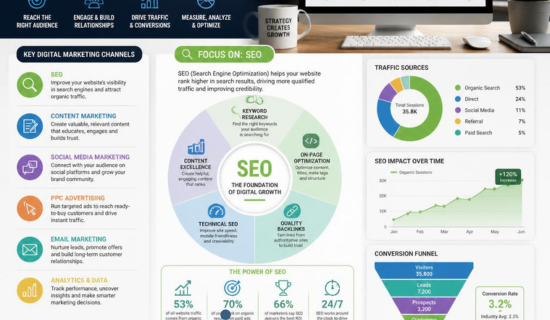
Digital marketing + SEO combines broader online marketing strategies with search engine optimization to help businesses attract the right audience, build visibility, generate leads, and increase conversions.
Digital marketing can include content marketing, social media marketing, email marketing, paid advertising, influencer marketing, and conversion optimization. SEO, or search engine optimization, focuses on improving a website’s visibility in organic search results.
The two strategies work best together.
For example, SEO can attract someone searching for a solution on Google, while content marketing educates that visitor, email marketing nurtures the relationship, and conversion optimization encourages them to become a customer.
Google’s current guidance emphasizes helpful, reliable, people-first content rather than content created primarily to manipulate rankings. SEO remains valuable when it supports a genuinely useful experience.
Why Is SEO Important in Digital Marketing? digital marketing & seo
SEO is one of the most sustainable components of a digital marketing strategy because it can continuously attract people who are actively searching for products, services, answers, or solutions.
A strong SEO strategy can help you:
- Increase organic traffic
- Improve search visibility
- Reach high-intent users
- Generate qualified leads
- Build brand authority
- Reduce dependence on paid advertising
- Increase website conversions
- Support long-term online growth
Unlike advertising, where traffic generally stops when spending stops, successful organic search visibility can continue generating visitors after the initial content and optimization work.
However, SEO should not be treated as a standalone tactic. It should connect with the entire digital marketing funnel.
How Do SEO and Digital Marketing Work Together?
Think of digital marketing as the complete system and SEO as one of its most important acquisition channels.
A typical customer journey might look like this:
Search → Website → Content → Trust → Lead → Conversion → Retention
SEO brings the potential customer to your website.
Content marketing answers their questions.
Strong website optimization creates a better experience.
Conversion rate optimization turns visitors into leads or customers.
Email marketing and remarketing can then help maintain the relationship.
This integrated approach is much stronger than trying to rank a page for a keyword without considering what happens after the visitor arrives.
The Main Types of SEO in Digital Marketing
1. Keyword Research
Keyword research identifies the words and questions your target audience uses when searching online.
Modern keyword research should go beyond search volume. Consider:
- Search intent
- Relevance
- Competition
- Business value
- Long-tail keywords
- Related questions
- Commercial intent
- Informational intent
For example, someone searching “what is SEO” has a different intent from someone searching “SEO agency for small business.”
Understanding that difference helps you create content that satisfies the actual search journey.
Battle-Tested On Page SEO Service Framework for Massive Growth
2. On-Page SEO, digital marketing & seo
On-page SEO improves the content and structure of individual webpages.
Important elements include:
- SEO title
- H1 and subheadings
- Search-intent alignment
- Keyword placement
- Internal links
- Descriptive URLs
- Image optimization
- Alt text
- Readability
- Helpful supporting content
- Clear calls to action
Google recommends using words that people actually search for in prominent and descriptive areas of a page, while its language systems can understand related queries without requiring every keyword variation to appear verbatim. Powerful On Page SEO Optimization Tools to Dominate Google Rankings
3. Technical SEO
Technical SEO helps search engines discover, crawl, understand, and index your website.
Key areas include:
- XML sitemaps
- Robots.txt
- Canonical URLs
- HTTPS
- Mobile usability
- Page speed
- Core Web Vitals
- Crawlability
- Indexing
- Redirects
- Duplicate content
- Structured data
Technical SEO does not replace quality content. Instead, it ensures valuable content can be properly accessed and understood by search engines.
Top SEO Services Near Me for Small Business Growth

4. Off-Page SEO
Off-page SEO focuses on signals beyond your own website.
Common activities include:
- Earning quality backlinks
- Digital PR
- Brand mentions
- Guest contributions
- Industry relationships
- Link-worthy research
- Expert collaborations
The goal should be building authority and reputation rather than acquiring large numbers of low-quality backlinks.
SaaS Write for Us Opportunities That Deliver Real SEO Results
5. Local SEO
Local SEO helps businesses appear when people search for products and services in specific geographic areas.
Important components include:
- Google Business Profile
- Local keyword targeting
- Consistent business information
- Customer reviews
- Local landing pages
- Relevant local links
- Location-specific content
For service businesses, local SEO can become a major source of qualified leads.
6. Ecommerce SEO
Ecommerce SEO focuses on making product and category pages discoverable in organic search.
Important areas include:
- Product titles
- Category architecture
- Product descriptions
- Internal linking
- Structured data
- Image optimization
- Faceted navigation
- Product reviews
- Search-friendly URLs
The objective is not simply more traffic. It is more relevant traffic that has purchasing intent.
Modern SEO Secrets: Powerful Strategies to Beat the Algorithm
Content Marketing + SEO: Why They Belong Together
Content marketing and SEO are closely connected.
SEO identifies what people are searching for, while content provides the information that satisfies those searches.
A strong content strategy can include:
- Blog posts
- How-to guides
- Comparison articles
- Case studies
- Original research
- Tutorials
- FAQs
- Glossaries
- Product guides
- Industry reports
The best content does more than repeat information already available online. Google specifically encourages original information, substantial coverage, insightful analysis, and content that provides meaningful value compared with competing results. Dell or HP Laptop: Which Is Better? Honest Reviewhttps://wonbolt.com/dell-vs-hp-laptops/
Search Intent Should Drive Your SEO Strategy
Search intent is the reason behind a search query.
The major categories include:
Informational:
The user wants to learn something.
Navigational:
The user wants to find a specific website or brand.
Commercial:
The user is researching options before making a decision.
Transactional:
The user is ready to take action or make a purchase.
For example:
- “what is digital marketing” → informational
- “best SEO tools” → commercial
- “SEO agency pricing” → commercial
- “hire an SEO agency” → transactional
Matching content to intent is more important than repeatedly inserting an exact keyword.
The Shocking Truth About Gemstone Malachite Most Buyers Don’t Know
AEO, GEO and AI Search: What Has Changed?
Search is increasingly conversational. Users may ask longer questions and expect direct answers from AI-powered search experiences.
This has created growing interest in Answer Engine Optimization (AEO) and Generative Engine Optimization (GEO).
However, there is an important distinction: Google says there are no special technical requirements or separate markup specifically required for AI Overviews or AI Mode. Existing SEO fundamentals remain the foundation.
To make content easier for search engines and AI systems to understand:
- Answer important questions directly.
- Use descriptive headings.
- Organize information logically.
- Provide concise definitions.
- Support claims with credible sources.
- Include original insights and examples.
- Keep important information in text.
- Use relevant internal links.
- Ensure structured data accurately reflects visible content.
Google also explains that AI search can use techniques such as query fan-out to explore related searches, making comprehensive coverage of a topic useful when it genuinely helps users. Submit Guest Posts – Connected Cars, IoT & Emerging Tech
How to Build a Digital Marketing + SEO Strategy
A practical strategy can follow these seven steps:
Step 1: Define Your Audience
Identify who you want to reach, what they need, and what problems your product or service solves.
Step 2: Research Search Demand
Find relevant keywords, questions, topics, competitors, and search intent.
Step 3: Build Topic Clusters
Create a central pillar page supported by related articles that cover specific subtopics.
For example:
Digital Marketing + SEO
→ Keyword Research
→ Technical SEO
→ Content Marketing
→ Local SEO
→ On-Page SEO
→ Link Building
→ SEO Analytics
→ Conversion Optimization
Step 4: Optimize Your Website
Improve technical SEO, site architecture, internal linking, mobile usability, page speed, and content structure.
Step 5: Publish Helpful Content
Create content that answers real questions and adds something valuable rather than simply rewriting competing pages.
Step 6: Promote and Build Authority
Use digital PR, social media, partnerships, email marketing, and legitimate link-earning strategies to expand your reach.
Step 7: Measure Results
Track:
- Organic traffic
- Search impressions
- Click-through rate
- Keyword visibility
- Leads
- Conversions
- Engagement
- Revenue
Google recommends evaluating your content based on whether visitors actually find it useful and satisfying—not simply whether it was created to attract search traffic.
Common Digital Marketing + SEO Mistakes
Avoid these common problems:
Keyword stuffing: Repeating keywords unnaturally can damage readability and does not create better content.
Publishing for volume: More pages do not automatically mean more visibility. Google specifically warns against producing large amounts of content primarily to capture search traffic.
Ignoring technical SEO: Excellent content cannot perform effectively if important pages cannot be crawled or indexed.
Chasing backlinks: Quantity should never replace relevance, quality, and genuine authority.
Ignoring conversion optimization: Traffic without leads or sales is not a successful marketing strategy.
Creating generic AI content: AI can assist research and production, but valuable content still needs accuracy, originality, expertise, editing, and a clear purpose. Google’s guidance focuses on content quality rather than simply whether AI was used.
How to Measure SEO Success
SEO success should be measured against business objectives, not rankings alone.
A useful measurement framework is:
Visibility → Traffic → Engagement → Leads → Customers → Revenue
Use tools such as Google Search Console and Google Analytics to understand how users discover and interact with your website.
Look beyond impressions and clicks. Ask:
- Are the right people visiting?
- Are visitors engaging with important pages?
- Are organic visitors becoming leads?
- Which pages generate revenue?
- Which search queries bring qualified prospects?
This turns SEO from a traffic-generation exercise into a measurable digital marketing channel.
Frequently Asked Questions
Is SEO part of digital marketing?
Yes. SEO is one of the core components of digital marketing. It focuses on improving organic search visibility, while digital marketing encompasses a broader range of online customer-acquisition and retention strategies.
Which is better: SEO or digital marketing?
They should not be viewed as competitors. SEO is a component of digital marketing. The strongest strategy combines SEO with content marketing, social media, email, paid campaigns, analytics, and conversion optimization where appropriate.
Does SEO still matter with AI search?
Yes. Google states that existing SEO best practices remain relevant to AI Overviews and AI Mode. Pages still need to meet Search’s technical requirements and provide helpful, reliable content.
How long does SEO take to work?
SEO does not have a guaranteed timeline. Results depend on competition, website quality, authority, content, technical health, search demand, and the improvements being made. Google notes that some changes can take days to show effects, while broader improvements may take several months to be reflected in its systems.
What is the most important part of SEO?
There is no single tactic that guarantees rankings. A successful SEO strategy combines helpful content, search-intent alignment, technical accessibility, strong website structure, authority, and a good user experience.
Final Takeaway
Digital marketing + SEO is most powerful when treated as one connected growth system rather than a collection of isolated tactics.
SEO helps people discover your business. Content answers their questions. Strong website experiences build trust. Conversion optimization turns attention into action, while email, social media, and other digital channels help build lasting customer relationships.
The biggest shift in modern SEO is not simply optimizing for another algorithm. It is creating content that genuinely satisfies people while making your website easy for search engines to discover, understand, and surface.
As Google continues expanding AI-powered search, the fundamentals remain remarkably consistent: help people, provide original value, demonstrate credibility, understand their intent, and build a technically sound website.