



Best IT Infrastructure Management Services: Proven Solutions for Maximum Uptime
IT infrastructure management services. Most marketers are experimenting with AI tools like Claude, but very few are thinking about infrastructure, limits, or data risk until something breaks. This article reframes Claude not as a “tool” but as a system that needs to be implemented intentionally—covering rate limits, data protection, and scalable workflows. The goal is to help marketers move from casual use to safe, reliable integration.
How Marketers Can Use Claude AI Safely Without Hitting Rate Limits or Risking Client Data
Most marketers start using Claude the same way: copy, paste, prompt, repeat.
It works—until it doesn’t.
You hit a rate limit mid-task—a workflow breaks. Or worse, you realize that sensitive client data has been floating around in prompts without any real safeguards.
The issue isn’t Claude itself. It’s how it’s being used. Technical SEO Specialist Explained: Everything You Need to Know
If you’re treating AI like a one-off tool, you’ll keep running into friction. If you treat it like part of your infrastructure—similar to how teams approach
it as afoundation for reliability and scale—everything changes.
What Are the Best Off-Page SEO Techniques in 2026?

Let’s walk through how to actually implement Claude in a way that’s safe, scalable, and built for real marketing workflows.
Dominate Search Results with Expert on Page SEO Optimization Strategies
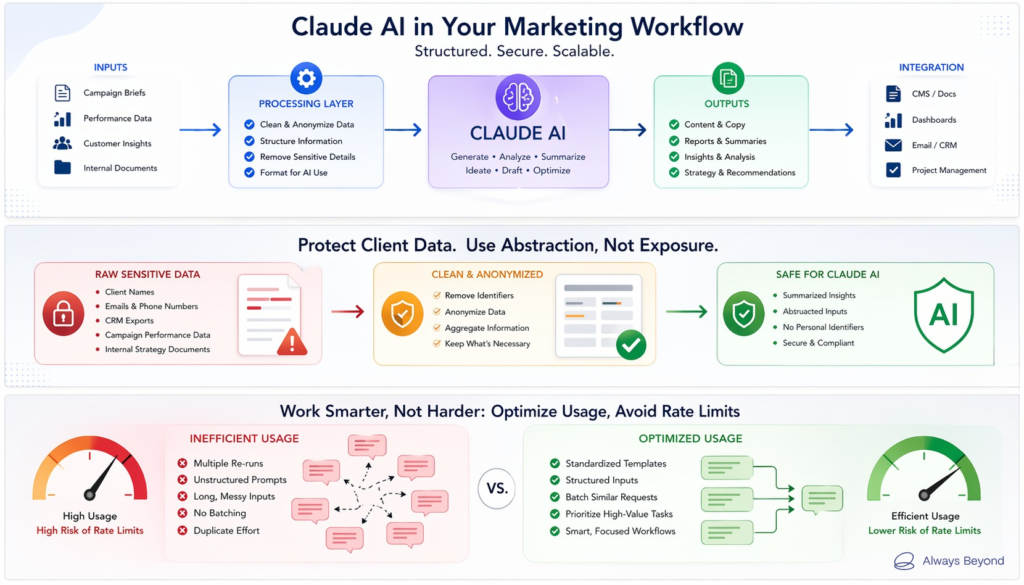
1. Stop Thinking in Prompts. Start Thinking in Systems.
Most teams use Claude reactively:
- Write an ad
- Summarize a doc
- Brainstorm ideas
That’s fine for experimentation—but it doesn’t scale.
Instead, think in terms of repeatable workflows:
- Content generation pipelines
- Reporting summaries
- Client communication drafts
- Campaign analysis frameworks: Best AI Voice Cloning Tools in 2026 (Tested & Ranked)
When you define repeatable use cases, you can:
- standardize prompts
- Reduce unnecessary API calls
- Avoid hitting rate limits randomly
The shift: from “What should I ask Claude?” to “Where does Claude fit in our process?”
Everything You Need to Know About Google AI Studio Free AI Tools (2026 Edition)
2. Rate Limits Aren’t the Problem—Unstructured Usage Is
Hitting rate limits usually isn’t about volume alone. It’s about inefficiency.
Common issues:
- Re-running prompts multiple times
- Sending overly long, unstructured inputs
- No batching or prioritization of tasks
- Multiple team members are duplicating work I tested 10 AI Voice Changers – Here’s the Best One
To avoid this:
Create structured usage rules
- Define when Claude should be used vs. when it shouldn’t
- Standardize prompt templates for recurring tasks. Best Artificial Intelligence Voice Generators (Free & Paid 2026)
- Batch similar requests together instead of running them individually
AI Voice Generator for YouTube: Best Tools, Monetization & How to Start in 2026
Prioritize high-value tasks
Don’t burn usage on low-impact work. Focus on:
- strategy support
- content frameworks
- data interpretation
- repeatable outputs
The result: fewer calls, better outputs, and far less friction.
Best laptop for Hacking, Exploring with AI, and powerful Recommendations
3. Protecting Client Data Isn’t Optional
This is where most marketing teams get sloppy.
If you’re pasting:
- client reports
- CRM exports
- campaign performance data
- internal strategy docs
…into Claude without thinking about it, you’re taking unnecessary risks.
ASUS ROG Zephyrus G16 Price Guide – Is this the Best Gaming Laptop in 2026?
Best practices to follow:
1. Never input raw sensitive data
Before using Claude:
- remove names, emails, phone numbers
- anonymize client identifiers
- strip out anything that could trace back to a real person or account
2. Use abstraction instead of exposure
Instead of:
“Here’s Client X’s full campaign data…”
Use:
“Here’s a summarized version of campaign performance…”
You still get value—without exposing sensitive information.
3. Create internal guidelines
Every team should have a simple rule set:
- What can be shared
- What must be anonymized
- Things should never be entered
This isn’t overkill. It’s basic operational hygiene.
IT infrastructure management services
Top Tools for Video Editing (Free & Paid AI Editors You’ll Love)
4. Build a Middle Layer (This Is the Real Upgrade)
If you’re serious about scaling Claude usage, you need a buffer between your raw data and the AI.
This can be:
- a Google Sheet that processes and cleans inputs
- an internal dashboard
- a lightweight tool or script
- or even a structured doc template
The goal is simple:
Claude should never touch raw, messy, or sensitive data directly.
Instead:
- Data gets cleaned
- Data gets structured
- Claude receives only what it needs
This reduces:
- risk
- token usage
- inconsistencies
And improves:
- output quality
- reliability
- scalability
Dominate Search Results with Expert on Page SEO Optimization Strategies
5. Treat Claude Like Part of Your Infrastructure
Here’s the mindset shift most teams miss:
Claude isn’t just a writing assistant.
It’s part of your operational stack. Best Budget Laptop for Students (Save Money Now)
That means:
- It needs defined use cases
- Artificial Intelligence needs guardrails
- It needs structured inputs
- Artificial Intelligence demands to be integrated with your workflows
When you approach it this way, you stop:
- overusing it
- misusing it
- or exposing unnecessary data
And you start building something that actually compounds over time.
AI Productivity Tools 2026: How Top Teams Automate and Outperform
What This Means in Practice
If you implement even a few of these changes:
- You’ll hit rate limits less often
- Your outputs will improve
- The team will move faster
- Your risk exposure drops significantly
More importantly, Claude becomes an asset—not a liability.
Top Tools for Video Editing (Free & Paid AI Editors You’ll Love)
Final Thought
Most marketers are still in the “experimenting” phase with AI.
The advantage now isn’t just using tools like Claude.
It’s using them properly—with structure, intention, and systems behind them.
That’s what separates teams that get marginal gains from the ones that build real leverage. Best Women’s Business Laptop Bags That Look Professional
If you’re thinking about how tools like Claude fit into your broader stack, it’s worth understanding the bigger picture of how infrastructure supports performance.
Social / Newsletter Teaser
Most marketers are using Claude wrong—and it shows up in broken workflows, rate limits, and data risk. Here’s how to actually implement it properly.
🔹 FAQ
1. What are IT infrastructure management services?
IT infrastructure management services refer to the monitoring, maintenance, optimization, and support of an organization’s IT systems, including servers, networks, cloud environments, databases, and security systems. These services ensure smooth business operations, improved performance, and minimal downtime.
2. Why are IT infrastructure management services important for businesses?
They help businesses maintain system reliability, enhance cybersecurity, reduce downtime, and improve overall efficiency. With proper infrastructure management, companies can focus on growth while experts handle technical operations.
3. What is included in IT infrastructure management services?
IT infrastructure management typically includes:
- Network management
- Server monitoring and maintenance
- Cloud infrastructure management
- Data storage and backup solutions
- Cybersecurity and compliance
- Helpdesk and IT support
4. What are the benefits of IT infrastructure management services?
Key benefits include improved system performance, reduced operational costs, enhanced security, scalability, proactive issue detection, and 24/7 monitoring.
5. What is the difference between IT infrastructure management and IT support?
IT infrastructure management is proactive and focuses on maintaining and optimizing systems, while IT support is reactive and resolves user issues and technical problems as they arise.
6. How do IT infrastructure management services improve security?
These services implement firewalls, intrusion detection systems, regular security updates, vulnerability assessments, and compliance protocols to protect against cyber threats and data breaches.
7. What is cloud infrastructure management in IT services?
Cloud infrastructure management involves managing cloud-based resources like servers, storage, and applications. It ensures scalability, performance optimization, and cost efficiency in cloud environments such as AWS, Azure, or Google Cloud.
8. Who needs IT infrastructure management services?
Small businesses, startups, enterprises, and organizations with digital operations need these services to ensure seamless IT performance, security, and scalability.
9. How much do IT infrastructure management services cost?
Costs vary depending on business size, infrastructure complexity, and service scope. Pricing can range from monthly managed service packages to custom enterprise solutions.
10. What is managed IT infrastructure?
Managed IT infrastructure refers to outsourcing IT operations to a third-party provider who handles monitoring, maintenance, security, and optimization of IT systems.
11. How do IT infrastructure services reduce downtime?
By using proactive monitoring, automated alerts, and preventive maintenance, IT infrastructure services identify and resolve issues before they cause system failures.
12. What tools are used in IT infrastructure management?
Common tools include:
- Nagios
- Zabbix
- SolarWinds
- Microsoft System Center
- AWS CloudWatch
13. Can IT infrastructure management services help with scalability?
Yes, these services enable businesses to scale their IT resources efficiently by optimizing infrastructure and integrating cloud solutions based on demand.
14. What industries benefit from IT infrastructure management services?
Industries such as healthcare, finance, e-commerce, education, and technology heavily rely on these services to maintain secure and efficient operations.
15. How to choose the best IT infrastructure management service provider?
Look for providers with proven experience, strong security practices, 24/7 support, scalable solutions, positive client reviews, and transparent pricing.