


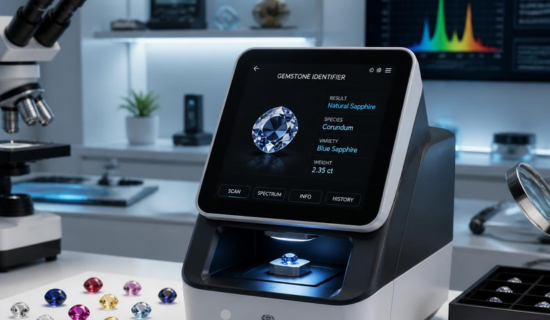
Whether you’re buying a gemstone for jewelry, starting a crystal collection, or simply curious about a stone you found, using a reliable gemstone identifier can help you make informed decisions. Today, identification is easier than ever thanks to AI-powered gemstone identifier apps, traditional gemstone identification charts, and professional gemological equipment.
However, not every identification method provides the same level of accuracy. While a gem identifier app can quickly suggest possible matches from a photo, valuable gemstones often require laboratory testing and professional evaluation.
In this guide, you’ll learn how to identify gemstones, compare manual and AI identification methods, understand when to use a gemstone identifier machine, and discover practical tips to avoid buying fake or misrepresented stones.
Stunning Gemstone Jewelry Guide: Unlock the Beauty of Precious Stones
What Is a Gemstone Identifier?
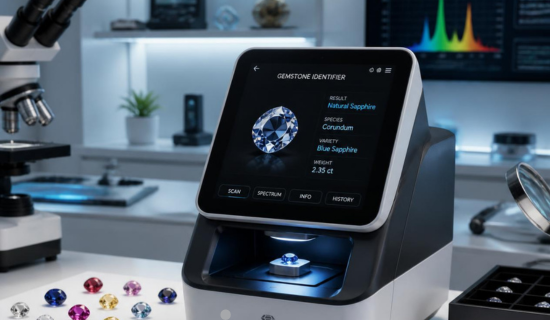
A gemstone identifier is any tool, resource, or method used to determine the identity and authenticity of a gemstone. Depending on your needs, identification can range from a simple visual comparison to advanced laboratory analysis.
The most common types include:
- AI-powered gemstone identifier apps
- Gem identification reference books
- Gemstone identification charts
- Professional gemological instruments
- Laboratory testing by certified gemologists
Each method examines one or more physical characteristics of a gemstone, such as:
- Color
- Transparency
- Luster
- Hardness
- Crystal structure
- Specific gravity
- Refractive index
- Inclusions
The more characteristics you evaluate, the more accurate the identification becomes.
Manual Gem Identification
Many collectors begin with visual inspection. By comparing a gemstone’s appearance with a trusted gemstone identification chart, you can often narrow it down to a few possibilities.
For example:
- A deep red stone may resemble ruby, garnet, or red spinel.
- A green gemstone could be emerald, jade, peridot, or green tourmaline.
- A blue stone might be sapphire, topaz, aquamarine, or blue zircon.
Color alone is never enough to confirm identity, as many gemstones share similar shades.
AI Gemstone Identifier Apps
Modern gemstone identifier apps use artificial intelligence and image recognition to analyze photos of gemstones. After scanning an image, the app compares visual features against a large gemstone database and suggests possible matches.
These apps are useful for:
- Beginners learning about gemstones
- Hobby collectors
- Jewelry enthusiasts
- Quick identification during shopping
- Educational purposes
Keep in mind that AI results are estimates. Lighting, camera quality, stone cut, and image angles can all affect accuracy.
Powerful Guide to Gemstone Names and Colors for Beginners
Professional Gem Identification
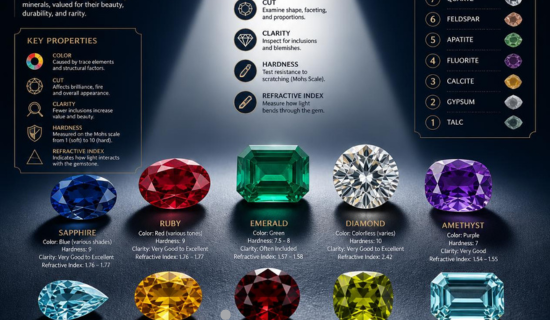
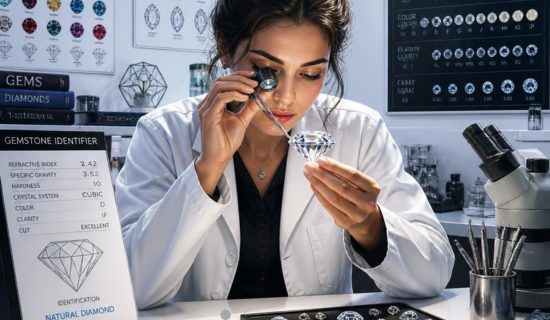
Professional gemologists use specialized instruments to analyze gemstones with much greater precision. This approach is essential when identifying valuable gemstones such as diamonds, rubies, sapphires, emeralds, or rare collector stones.
Professional identification often includes:
- Microscopic examination
- Optical testing
- Hardness evaluation
- Refractive index measurement
- Spectral analysis
The result is usually a gemstone report or certificate that confirms the stone’s identity and key characteristics.
Why Accurate Gemstone Identification Matters
Correct gemstone identification isn’t just about knowing a stone’s name—it protects your investment, helps you avoid scams, and ensures you’re purchasing what you expect.
Prevent Buying Fake Gemstones
The gemstone market includes natural stones, synthetic gems, treated gemstones, and inexpensive imitations made from glass or other materials. Without proper identification, it’s easy to mistake one for another.
For example:
- Glass can imitate ruby.
- Cubic zirconia resembles diamond.
- Dyed quartz may look like more expensive gemstones.
- Synthetic sapphire can appear nearly identical to natural sapphire.
Using multiple identification methods reduces the risk of costly mistakes.
The Shocking Truth About Gemstone Malachite Most Buyers Don’t Know
Understand the True Value
Two gemstones that look nearly identical can have dramatically different values depending on their origin, rarity, treatment, and authenticity.
A natural untreated ruby, for example, is generally worth significantly more than a synthetic ruby of similar appearance. Accurate identification helps buyers and sellers determine fair market value.
Choose the Right Gemstone for Jewelry
Different gemstones vary in durability. Knowing a stone’s hardness helps you select one that’s suitable for rings, necklaces, bracelets, or everyday wear.
For instance:
- Diamond (Mohs 10) is highly resistant to scratching.
- Sapphire and ruby (Mohs 9) are excellent for daily wear.
- Emerald (Mohs 7.5–8) is beautiful but requires more care due to natural inclusions.
- Opal (Mohs 5.5–6.5) is softer and better suited for occasional wear.
Understanding these properties helps you make practical purchasing decisions.
Verify Authenticity Before Selling
If you plan to resell or insure a gemstone, professional identification provides documentation that increases buyer confidence and supports accurate valuation.
Many reputable jewelers and collectors prefer gemstones accompanied by certification from recognized gemological laboratories.
How to Identify Gemstones at Home
If you’re wondering how to identify gemstones without specialized equipment, start with careful observation. While home methods can’t replace professional testing, they can help you distinguish between common gemstone types.
Gemstone Home Décor Masterclass: Best Gemstones, Room Ideas & Styling Secrets
1. Examine the Color
Color is usually the first characteristic people notice, but it shouldn’t be your only reference.
Look for:
- Hue
- Tone
- Saturation
- Color consistency
- Natural color zoning
Natural gemstones often display subtle variations rather than perfectly uniform color.
2. Check Transparency
Observe how much light passes through the stone.
Gemstones can be:
- Transparent
- Translucent
- Opaque
This simple observation immediately narrows the list of possible gemstones.
What Gemstone Is June? Discover the 3 Beautiful June Birthstones
3. Look for Inclusions
Use a 10× jeweler’s loupe to inspect the interior of the stone.
Natural gemstones frequently contain tiny inclusions formed during their geological development. Perfectly flawless stones may be synthetic or imitation materials, although there are exceptions.
4. Evaluate the Luster
Luster describes how light reflects from the gemstone’s surface.
Common types include:
- Vitreous (glass-like)
- Pearly
- Waxy
- Silky
- Resinous
- Metallic
Different minerals display distinctive lusters that aid identification.
5. Consider Hardness (Safely)
The Mohs Hardness Scale measures a gemstone’s resistance to scratching.
Avoid scratching valuable gemstones directly, as improper testing can cause permanent damage. Instead, use hardness information alongside other identification methods rather than relying on destructive tests. Discover the Magical Birth Gemstone December and Its Powerful Symbolism
Gemstone Identification Chart
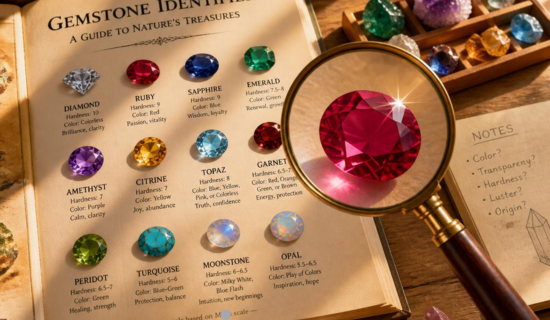
A gemstone identification chart helps narrow down a gemstone by comparing its physical properties. While no chart can guarantee an exact identification, it’s an excellent starting point before using a gemstone identifier app or consulting a professional gemologist.
| Gemstone | Common Color | Mohs Hardness | Transparency | Typical Use |
|---|---|---|---|---|
| Ruby | Red | 9 | Transparent | Fine Jewelry |
| Sapphire | Blue (also other colors) | 9 | Transparent | Rings & Necklaces |
| Emerald | Green | 7.5–8 | Transparent | Luxury Jewelry |
| Amethyst | Purple | 7 | Transparent | Jewelry & Collecting |
| Citrine | Yellow | 7 | Transparent | Everyday Jewelry |
| Garnet | Deep Red | 6.5–7.5 | Transparent | Rings & Pendants |
| Topaz | Blue, Yellow, Pink | 8 | Transparent | Jewelry |
| Aquamarine | Light Blue | 7.5–8 | Transparent | Fine Jewelry |
Pro Tip: Never rely on color alone. Gemstones with similar colors can have different hardness, density, and optical properties. Comparing multiple characteristics leads to more accurate identification.
Engagement Rings Emerald: The Most Underrated Luxury Ring Design
Best Gemstone Identifier Apps
If you’re new to gemstone collecting, a gemstone identifier app is one of the easiest ways to begin. These apps use AI image recognition to compare your stone with extensive gemstone databases.
Look for apps that offer:
- AI photo recognition
- Large gemstone databases
- Identification confidence scores
- Educational information
- Offline reference guides
- Mineral and crystal identification
Advantages
- Beginner-friendly
- Quick photo-based analysis
- Portable for shopping or travel
- Helpful learning tool
Limitations
AI apps analyze appearance only. They cannot measure important gemological properties such as refractive index, specific gravity, or internal optical characteristics. For valuable gemstones, always confirm results through professional testing.
Discover the Fascinating Birthstone of June: Hidden Meanings & Stunning Beauty
How AI Is Changing Gemstone Identification
Modern AI is making gemstone identification faster and more accessible for hobbyists, jewelers, and collectors. Instead of relying solely on visual comparison, AI-powered gemstone identifier apps analyze photos using computer vision and machine learning to recognize patterns, colors, shapes, and textures.
When you upload an image, the AI compares it against thousands of gemstone images and characteristics to suggest the most likely match within seconds.
How AI Identifies Gemstones
Most AI gemstone identification tools evaluate several visible features, including:
- Color and hue
- Transparency
- Surface texture
- Cut and shape
- Light reflection
- Visible inclusions
- Pattern recognition
- Edge characteristics
Some advanced platforms also combine image recognition with gemstone databases to estimate possible gemstone species and provide educational information about hardness, origin, and common uses.
Benefits of AI Gemstone Identification
AI offers several advantages for everyday users:
- Fast photo-based analysis
- Easy to use for beginners
- Portable identification on smartphones
- Helpful for learning about gemstones
- Quick comparison of similar-looking stones
- Useful when shopping online or visiting jewelry stores
Limitations of AI
Despite its capabilities, AI cannot replace professional gemological testing.
Current AI systems generally cannot reliably determine:
- Natural vs. synthetic gemstones
- Heat or fracture treatments
- Refractive index
- Specific gravity
- Internal crystal structure
- Laboratory-grade authenticity
For rare, expensive, or investment-quality gemstones, certification from a professional gemologist remains the most reliable option.
Discover the Fascinating Birthstone of June: Hidden Meanings & Stunning Beauty
AI + Human Expertise = The Best Results
The most accurate approach combines AI with traditional gemological methods. You can use a gemstone identifier app to narrow down possibilities, verify physical properties with a gemstone identification chart, inspect the stone using a jeweler’s loupe, and seek professional testing for high-value gems.
This combination delivers greater confidence than relying on any single identification method.
Professional jewelers and gemologists use specialized equipment that provides much more reliable results than photo-based identification.
Gemstone Identifier Machine
Common gemstone identifier machines include:
Refractometer
Measures how light bends inside a gemstone, one of the most reliable identification methods.
Gem Microscope
Reveals inclusions, growth patterns, and treatments invisible to the naked eye.
Polariscope
Determines optical properties and helps distinguish between different gemstone species.
Spectroscope
Analyzes how gemstones absorb light, assisting in identifying minerals with similar appearances.
Electronic Gem Tester
Useful for separating diamonds, moissanite, and certain simulants.
These tools are commonly used by jewelry stores, pawn shops, gemological laboratories, and experienced collectors.
Recommended Amazon Tools for Gemstone Identification
If you’re building a home gemstone identification kit, these tools offer excellent value for beginners and enthusiasts.
1. 10× Jeweler’s Loupe
Ideal for examining inclusions, surface scratches, and craftsmanship. It’s one of the first tools every gemstone collector should own.
2. Digital Jewelry Scale
Accurate gemstone weight is an important factor in identification and valuation. A precision scale that measures to 0.01 g is suitable for most hobbyists.
3. UV Flashlight
Some gemstones fluoresce under ultraviolet light, making a UV flashlight a useful addition to your identification toolkit.
4. Gemstone Refractometer (Advanced Users)
A refractometer measures refractive index, helping distinguish gemstones with similar appearances. This tool is best suited to serious hobbyists or aspiring gemologists.
Affiliate Tip for Wonbolt: Add Amazon affiliate links with a brief disclaimer such as, “As an Amazon Associate, we may earn from qualifying purchases at no extra cost to you.” Use descriptive anchor text like “Shop 10× Jeweler’s Loupe on Amazon” rather than generic “click here” links.
Traditional Gemstone Healing Chart
Many cultures have associated gemstones with symbolic meanings and spiritual traditions. While these beliefs are meaningful to many people, there is no scientific evidence that gemstones can diagnose, treat, or cure medical conditions.
| Gemstone | Traditionally Associated With |
|---|---|
| Amethyst | Calm and emotional balance |
| Rose Quartz | Love and compassion |
| Citrine | Positivity and confidence |
| Lapis Lazuli | Wisdom and communication |
| Tiger’s Eye | Courage and focus |
| Clear Quartz | Clarity and intention |
If you’re interested in gemstone healing, view these associations as cultural or personal practices rather than medical advice.
Common Mistakes When Identifying Gemstones
Even experienced collectors can make mistakes. Avoid these common pitfalls:
- Judging a gemstone by color alone.
- Trusting a single AI app without verification.
- Ignoring visible inclusions and clarity.
- Assuming every transparent stone is valuable.
- Performing destructive scratch tests on expensive gems.
- Buying high-value gemstones without certification.
Professional Gemstone Identification: When Should You Consult an Expert?
While AI apps, identification charts, and home inspection tools are useful, they cannot provide the certainty required for expensive or rare gemstones. If you’re buying an investment-grade gem, inheriting a family heirloom, or planning to resell a valuable stone, professional identification is the safest option.
Certified gemologists use specialized equipment to evaluate:
- Gemstone species and variety
- Natural vs. synthetic origin
- Treatments (heat, dyeing, fracture filling, etc.)
- Clarity characteristics and inclusions
- Carat weight and measurements
- Optical properties
- Overall authenticity
Many gemstones are accompanied by certificates from reputable gemological laboratories. These reports provide confidence for buyers, sellers, collectors, and insurers, especially when dealing with high-value stones.
Tips for Buying Genuine Gemstones
Whether you’re shopping online or in a jewelry store, following a few best practices can help you avoid costly mistakes.
Buy From Reputable Sellers
Choose jewelers or gemstone dealers with transparent business practices, clear return policies, and positive customer reviews.
Request a Certificate
For expensive gemstones such as diamonds, rubies, sapphires, or emeralds, ask for a gemological certificate from a recognized laboratory whenever available.
Compare Multiple Identification Methods
Don’t rely on a single photo or AI result. Use a combination of:
- A gemstone identifier app
- A gemstone identification chart
- Visual inspection with a jeweler’s loupe
- Professional verification for valuable purchases
Understand Pricing
If a gemstone is advertised at a price that seems unusually low compared to similar stones, investigate carefully. Significant price differences can indicate synthetic, treated, or imitation materials.
Choosing the Right Identification Method
Different users benefit from different tools depending on their goals.
| Your Goal | Best Identification Method |
|---|---|
| Learn about gemstones | Gemstone identification chart |
| Identify common stones quickly | Gemstone identifier app |
| Hobby collecting | Jeweler’s loupe + AI app |
| Buying expensive gemstones | Certified gemologist |
| Jewelry business | Professional gemstone identifier machine |
| Investment-grade gemstones | Laboratory certification |
Using more than one method generally leads to more reliable results than relying on a single source.
Conclusion
A reliable gemstone identifier helps you make smarter decisions whether you’re collecting minerals, purchasing jewelry, or evaluating inherited gemstones. From AI-powered gemstone identifier apps and detailed gemstone identification charts to professional gemstone identifier machines, each method has its own strengths.
For beginners, combining a trusted gem identifier app with careful visual inspection is an excellent starting point. As your knowledge grows, tools like a jeweler’s loupe, precision scale, and refractometer can improve your identification accuracy. For valuable gemstones, however, nothing replaces a certified gemologist and a professional laboratory report.
By understanding how to identify gemstones correctly and using multiple verification methods, you’ll reduce the risk of buying imitations, better understand gemstone quality, and make more confident purchasing decisions.
Frequently Asked Questions (SEO & AEO Optimized)
What is the best gemstone identifier?
The best gemstone identifier depends on your needs. Beginners often benefit from AI-powered apps, while professionals rely on gemological instruments such as refractometers and microscopes. For expensive gemstones, laboratory certification remains the most reliable option.
How accurate is a gemstone identifier app?
Most gemstone identifier apps provide a helpful starting point but cannot guarantee accuracy. Lighting conditions, photo quality, and similarities between different gemstones can affect the results. Professional testing is recommended for valuable stones.
How can I identify gemstones at home?
Start by examining the gemstone’s color, transparency, luster, inclusions, and hardness. Compare these characteristics with a gemstone identification chart and use a reputable AI identification app. Avoid destructive tests that may damage the stone.
What is a gemstone identifier machine?
A gemstone identifier machine is specialized equipment used by gemologists and jewelers to analyze optical and physical properties. Common examples include refractometers, microscopes, spectroscopes, and electronic gemstone testers.
Can AI identify gemstones accurately?
AI can recognize many common gemstones from photographs, making it useful for education and preliminary identification. However, AI cannot reliably determine treatments, synthetic origins, or subtle gemological characteristics, so it should not replace professional evaluation.
What is the difference between a natural and synthetic gemstone?
Natural gemstones form through geological processes over millions of years. Synthetic gemstones are created in laboratories with similar chemical compositions and physical properties but different origins. Both can look nearly identical without specialized testing.
Final Thoughts
Whether you’re identifying a gemstone found in nature, evaluating jewelry before purchase, or expanding your collection, combining modern AI tools with traditional gemological knowledge is the most reliable approach. A careful, informed process will help you appreciate gemstones for their beauty, authenticity, and long-term value.
Call to Action
Running a jewelry, gemstone, or eCommerce website? High-quality SEO content can help you attract qualified traffic and build authority in competitive search results.
Wonbolt specializes in:
- SEO blog writing
- AEO (Answer Engine Optimization)
- Topical authority content clusters
- Keyword research
- On-page SEO optimization
- Content strategy for long-term organic growth
📧 Contact: infowonbolt@gmail.com