



Artificial Intelligence Voice Recognition: Surprising Benefits & Practical Applications
Artificial intelligence voice recognition is changing the way people communicate with computers, smartphones, vehicles, smart devices, and business software. Instead of typing commands, users can simply speak and allow AI to recognize their words, understand their intent, and respond accordingly.
From AI transcription and virtual assistants to customer-service automation and accessibility tools, voice recognition technology is becoming an important part of the modern digital ecosystem.
But how does artificial intelligence voice recognition actually work? What are its benefits, applications, limitations, and security concerns? And what does the future hold for AI-powered voice technology?
International SEO Agency: The Ultimate Guide to Global SEO Growth
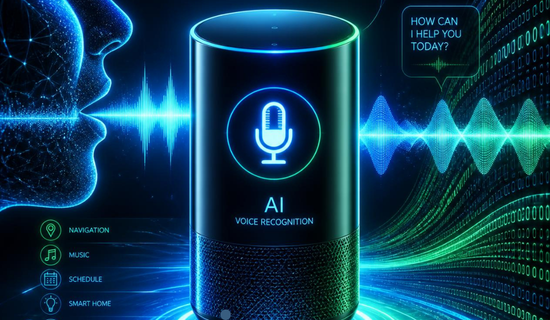
This guide answers these questions while explaining the technology in simple terms.
What Is Artificial Intelligence Voice Recognition?
Artificial intelligence voice recognition is technology that uses artificial intelligence, machine learning, and speech-processing algorithms to analyze human speech and convert it into useful digital information.
Basic speech recognition may simply convert spoken words into text. Advanced AI voice recognition can go further by understanding context, identifying intent, processing natural language, and triggering actions.
For example, when a user says, “Set a reminder for tomorrow at 9 AM,” an AI voice system can recognize the spoken words, understand the requested date and time, identify the user’s intention, and create the reminder.
In simple terms, artificial intelligence voice recognition allows computers to listen to human speech, understand it, and respond or take action.
How Does Artificial Intelligence Voice Recognition Work?
Modern AI voice recognition involves several stages.
1. Voice Capture
The process begins when a microphone captures the user’s speech and converts sound waves into a digital audio signal.
2. Audio Processing
The system processes the audio to reduce background noise and identify important speech patterns. This step is particularly useful in noisy environments such as offices, vehicles, restaurants, and public spaces.
3. Automatic Speech Recognition
Automatic speech recognition (ASR) technology analyzes the audio and determines which words were spoken.
Modern ASR systems use machine learning and deep-learning models trained on large amounts of speech and language data.
4. Natural Language Processing
After speech is converted into text, natural language processing (NLP) can help the system understand meaning and context.
For example, if someone says, “Find me a hotel in Dubai for next weekend,” the system needs to understand the action, destination, and time period rather than simply transcribing the sentence.
5. AI Response or Action
Finally, the AI system can provide an answer, display information, create a record, execute a command, or send the request to another application.
I Tested 10 AI Voice Changers – Here’s the Best One
This combination of speech recognition, machine learning, NLP, and automation makes modern voice AI much more capable than traditional voice-to-text software.
What Is the Difference Between Voice Recognition and Speech Recognition?
The terms voice recognition and speech recognition are often used interchangeably, but they can refer to different capabilities.
Speech recognition generally focuses on identifying and transcribing spoken words.
Voice recognition can refer to analyzing characteristics of a person’s voice, including identifying the speaker, although the term is also commonly used more broadly for voice-based interaction.
For example, speech recognition might understand the command:
“Open my calendar.”
A voice-recognition system may additionally analyze the speaker’s voice for personalization or authentication.
Best AI Voice Generators for YouTube (2026 Ultimate Guide)
The exact capabilities depend on the technology being used.
What Are the Benefits of AI Voice Recognition?
AI voice recognition provides several benefits for individuals and businesses. AI Voice Generator for YouTube: Best Tools, Monetization & How to Start in 2026
Faster Interaction
Speaking can be faster than typing, especially when users need to provide long instructions or information.
Hands-Free Operation
Voice technology allows people to interact with devices while driving, cooking, working, or performing other activities where using a keyboard or touchscreen is inconvenient.
Improved Accessibility
Voice interfaces can provide alternative ways for people to interact with digital devices, helping users who have difficulty using traditional input methods.
Automated Transcription
AI speech recognition can convert meetings, interviews, lectures, calls, and recordings into searchable text.
Better Customer Service
Businesses can use voice AI to answer routine questions, route calls, summarize conversations, and assist customer-service teams.
Increased Productivity
Voice commands can help employees create notes, dictate documents, summarize conversations, and automate repetitive tasks.
Best Artificial Intelligence Voice Generators (Free & Paid 2026)
Artificial Intelligence Voice Recognition Applications
AI voice recognition is being used across many industries.
Healthcare
Healthcare organizations can use AI speech recognition for transcription, documentation, scheduling, and hands-free interactions.
Because healthcare information can be highly sensitive, organizations must carefully consider privacy, security, accuracy, and applicable regulations.
Education
Schools, universities, teachers, and students can use voice technology for transcription, language learning, pronunciation practice, accessibility, and educational applications.
Customer Service
Contact centers can use speech recognition to transcribe calls, analyze conversations, identify customer problems, and automate routine interactions.
Automotive Technology
Modern vehicles increasingly use voice interfaces for navigation, communication, entertainment, and other functions, allowing drivers to interact with systems without constantly using a touchscreen.
Smart Homes
Voice AI can control compatible lights, thermostats, appliances, entertainment systems, and other connected devices.
Business Operations
Companies can use AI voice recognition for meeting transcription, dictation, voice commands, workflow automation, and employee productivity.
Accessibility
Voice-controlled technology can provide an alternative interface for users who cannot easily interact with conventional keyboards, mice, or touchscreens.
Best AI Voice Cloning Tools in 2026 (Tested & Ranked)
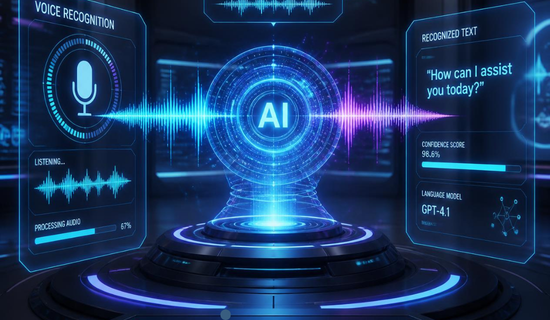
Is AI Voice Recognition Accurate?
AI voice recognition can be highly accurate under suitable conditions, but it is not perfect.
Accuracy can be affected by:
- Background noise
- Microphone quality
- Strong accents or dialects
- Multiple people speaking simultaneously
- Poor-quality recordings
- Unusual terminology
- Speaking speed
- Language differences
- Industry-specific vocabulary
Businesses should therefore test AI speech recognition using real-world audio before depending on it for important processes.
For applications where mistakes could have serious consequences, human review may still be necessary.
Artificial Intelligence Voice Recording Made Easy: Free & Paid Tools Explained
AI Voice Recognition vs. Traditional Voice Recognition
Traditional voice recognition systems often relied on predefined commands, limited vocabularies, or speaker-specific training.
Modern artificial intelligence voice recognition uses machine learning and increasingly sophisticated language models to process more natural conversations and varied speech patterns.
| Feature | Traditional Voice Recognition | AI Voice Recognition |
|---|---|---|
| Natural conversation | Limited | More advanced |
| Context understanding | Basic | More sophisticated |
| Vocabulary | Often restricted | Potentially extensive |
| Adaptation | Limited | Machine-learning based |
| Transcription | Basic | More advanced |
| Intent understanding | Limited | More sophisticated |
| Automation | Basic | Advanced |
However, advanced AI does not automatically guarantee perfect accuracy. The quality of the underlying model, data, microphone, environment, and implementation still matters. AI Voice Generator Free: Best Tools for YouTube Automation
Privacy and Security Concerns
Voice data can contain sensitive personal, financial, professional, or business information.
Organizations using AI voice recognition should consider:
- How voice recordings are collected
- Whether recordings are stored
- How long data is retained
- Who can access the information
- Whether data is encrypted
- How third-party providers process voice data
- Whether users provide appropriate consent
- How recordings and transcripts can be deleted
Businesses should clearly communicate their data practices and implement appropriate security controls before deploying voice AI at scale.
What Is the Future of Artificial Intelligence Voice Recognition?
The future of AI voice recognition is moving beyond basic speech-to-text applications.
Emerging developments include:
- More natural conversational AI
- Real-time voice assistants
- Multilingual voice interaction
- AI-powered voice agents
- Improved speaker separation
- Better recognition of accents and dialects
- Real-time translation
- More personalized voice interfaces
- Voice-controlled business automation
- Integration with multimodal AI systems
Voice AI is increasingly becoming part of larger AI systems rather than functioning as an isolated speech-to-text tool.
How to Optimize AI Voice Recognition Content for Google in 2026
Creating an article around artificial intelligence voice recognition requires more than repeating the target keyword.
Google’s current guidance says SEO remains relevant for generative AI search features because AI Overviews and AI Mode are built on Google’s core Search ranking and quality systems. Google also emphasizes unique, useful, people-first content rather than content created primarily to manipulate search visibility.
For this article, the best SEO approach is to:
Use the Primary Keyword Naturally
Use artificial intelligence voice recognition naturally in the title, introduction, relevant headings, body content, and metadata where appropriate.
Avoid excessive repetition or keyword stuffing.
Build a Strong Topic Cluster
Support the primary keyword with closely related concepts such as:
- AI voice recognition
- AI speech recognition
- speech-to-text AI
- automatic speech recognition
- natural language processing
- voice AI
- AI transcription
- conversational AI
- voice assistants
- AI voice technology
- machine learning voice recognition
This helps establish topical relevance without forcing exact-match keywords into every paragraph.
Answer Questions Directly
Answer-engine optimization works best when important questions receive clear, concise answers.
For example:
What is artificial intelligence voice recognition?
Artificial intelligence voice recognition is technology that uses AI and machine learning to process human speech, identify spoken words, understand meaning or intent, and generate an appropriate response or action.
Create Useful Supporting Content
A strong content cluster could include separate articles about AI voice generators, AI transcription tools, speech-to-text technology, conversational AI, AI agents, voice assistants, AI translation, and voice search.
These articles can be connected with relevant internal links to strengthen the overall topic architecture of the website.
Provide Original Value
Google’s latest generative-AI guidance specifically emphasizes valuable and non-commodity content. Simply rewriting information already available across hundreds of websites is unlikely to provide a strong competitive advantage.
Add original explanations, examples, comparisons, expert insights, practical use cases, trustworthy sources, and genuinely useful information.
Follow Technical SEO Fundamentals
Make sure the page is:
- Crawlable
- Indexable
- Mobile-friendly
- Fast and usable
- Properly internally linked
- Supported by descriptive titles and headings
- Accessible to users
- Supported by accurate structured data when applicable
Google’s current documentation confirms that there is no special technical requirement or special markup that guarantees visibility in generative AI search features. Existing SEO best practices remain the foundation.
Don’t Depend on Keyword Length or AI Tricks
There is no magic article length that guarantees rankings.
Likewise, publishers should not rely on supposed AEO or GEO hacks, special AI files, or unnatural content formatting as a shortcut to Google visibility. Google’s guidance specifically notes that standard SEO practices continue to matter for generative AI search.

Frequently Asked Questions About Artificial Intelligence Voice Recognition
What is artificial intelligence voice recognition?
Artificial intelligence voice recognition uses AI and machine learning to process human speech, recognize spoken language, understand context or intent, and generate an appropriate response or action.
How does AI voice recognition work?
It generally involves voice capture, audio processing, automatic speech recognition, natural language processing, and an AI-generated response or automated action.
Is AI voice recognition the same as speech-to-text?
No. Speech-to-text primarily converts spoken language into written text. Advanced AI voice recognition can also interpret intent, context, commands, and conversational meaning.
What are the main uses of AI voice recognition?
Common applications include transcription, virtual assistants, customer service, accessibility, automotive systems, smart homes, education, healthcare documentation, and business automation.
Is artificial intelligence voice recognition secure?
It can be secure when properly implemented, but organizations must carefully manage voice data collection, storage, access, encryption, retention, consent, and third-party processing.
What is the future of AI voice recognition?
AI voice recognition is expected to become increasingly conversational, multilingual, context-aware, real-time, and integrated with AI agents and multimodal systems.
Final Thoughts
Artificial intelligence voice recognition is transforming speech technology from simple voice-to-text software into a powerful interface for interacting with AI and digital systems.
Its applications now extend across customer service, healthcare, education, automotive technology, smart homes, accessibility, transcription, and business automation.
However, successful adoption requires more than choosing an advanced AI model. Organizations must consider accuracy, privacy, security, accessibility, user experience, and the specific requirements of their industry.
For publishers, the same principle applies to search visibility. The strongest strategy is to create useful, original, trustworthy content that directly satisfies the user’s search intent while maintaining strong technical SEO.
Google’s latest guidance confirms that traditional SEO fundamentals continue to support visibility in generative AI search experiences. The goal should therefore be simple: create content that genuinely helps people first, and optimize it properly for search second